
Ever felt a disposable mask, a medical gown, or even that silky-smooth teabag and wondered how they’re made? Spoiler alert: They might not be woven or knitted. Welcome to the world of wet laid nonwoven fabric, the unsung hero of high-performance textiles. It’s engineered—not sewn—into existence, and it’s quietly holding together everything from coffee filters to medical barriers.
Table of Contents
Let’s pull back the curtain on this precise, paper-like material.
What is Wet Laid Nonwoven Fabric?
Breaking Down the Basics
Imagine making fabric like making paper. That’s basically what wet laid nonwoven fabric is all about. Instead of weaving threads, this process suspends short fibers in water, disperses them evenly, and then lays them out to dry into a sheet.
You get a uniform, highly consistent material with fantastic surface smoothness. Think of it like making pancake batter: mix it too roughly, you get lumps. Mix it well, and it’s smooth, consistent, and ready for the pan.
Wet Laid vs. Other Nonwovens
Here’s where it gets nerdy. Compared to spunbond or melt blown nonwovens, wet laid uses a water-based dispersion system. No heat-driven spinning. No polymer melting.
And the results? Extremely fine fiber distribution—up to 90% uniformity across a large sheet. That’s why it dominates markets needing precise control, like HEPA filters and electrical insulation.
The Manufacturing Process
Step-by-Step Breakdown
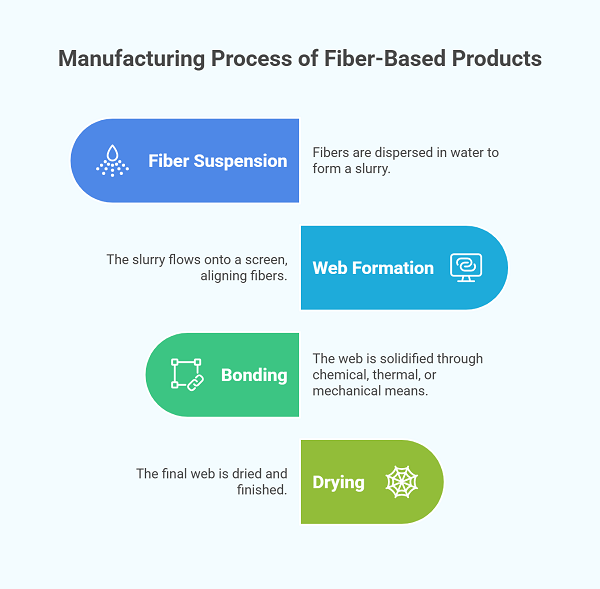
Let’s go factory-mode for a second. Here’s how it works:
- Fiber Suspension: Short fibers (less than 10 mm) are dispersed in water—usually at a 0.5% concentration.
- Web Formation: The slurry flows onto a moving screen. Water drains out. Fibers align flat.
- Bonding: Chemical, thermal, or mechanical bonding solidifies the web.
- Drying: The final web is dried, calendared, and finished.
Simple on paper. Painfully precise in practice.
Why Water? The Role of Liquids
Water isn’t just for show. It acts like a conductor in an orchestra—guiding each fiber to its place. Without it, there’s no uniform dispersion.
Stat alert: Wet laid processes can distribute fiber density with less than 5% variance across large production widths.
Materials Commonly Used
Common fiber options include:
- Cellulose (wood pulp)
- Polyester
- Glass fiber
- Aramid
- Carbon fiber (in high-end filters)
Sometimes a blend is used. For example, 50% polyester + 50% cellulose is popular in wipes and medical applications.
Key Properties That Set It Apart
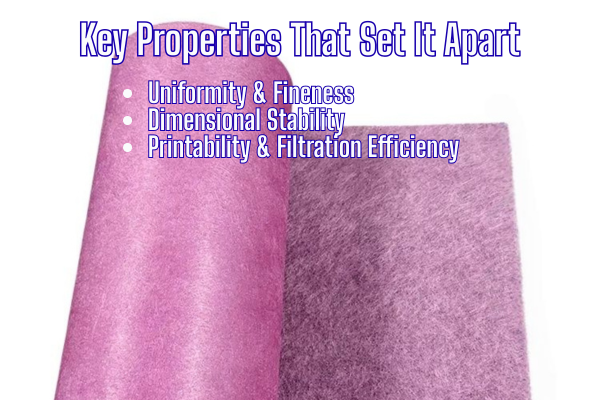
Uniformity & Fineness
This is the showstopper. The web’s evenness is unmatched. Want a filter with consistent porosity? Wet laid is your guy.
Dimensional Stability
Thanks to tight fiber packing, these fabrics don’t stretch or warp easily. They stay put—critical in electronic laminates or gasket sealing.
Printability & Filtration Efficiency
Need to print crisp logos or handle micron-level particles? Wet laid’s ultra-smooth surface supports high-res printing and filtration efficiency up to 99.97% @ 0.3 microns for HEPA applications.
Where It’s Used: Applications That Might Surprise You
Industrial & Filtration Media
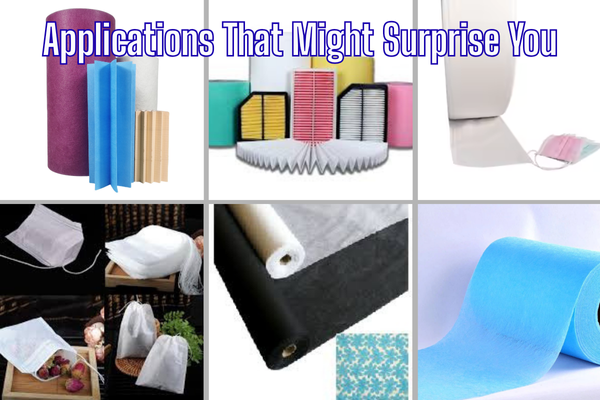
Air filters. Oil filters. Liquid filtration in pharmaceuticals. Wet laid shines here because of its low-pressure drop and high retention rate.
Medical & Hygiene Products
Face masks, surgical drapes, sterilization wraps. In fact, during the COVID-19 spike, demand for wet laid fabrics in masks alone surged by 35% globally.
Packaging, Wallpaper, and More
Tea bags? Check. Wallpaper backing? Yep. Even security paper (the stuff your diploma’s printed on). Its uniformity makes it tamper-resistant and easy to laminate.
Advantages and Limitations
Why Industries Love It
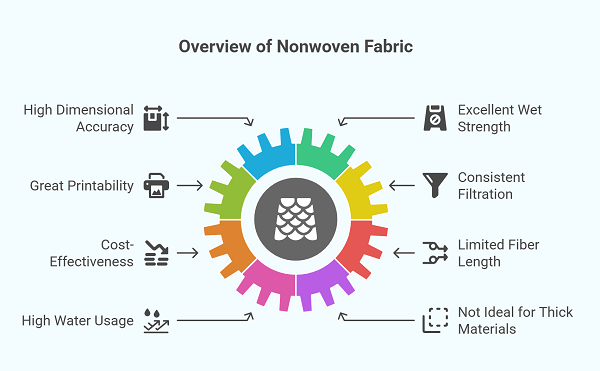
- High dimensional accuracy
- Excellent wet strength (with binders)
- Great printability
- Consistent filtration characteristics
Cost-wise? Reasonable—especially for high-volume production.
And the Not-So-Great Stuff
- Limited to short fibers only
- Requires lots of water (environmental impact)
- Not ideal for high-loft or thick materials
So no, it’s not replacing every fabric. But for what it does best, it dominates.
Final Thoughts: Is Wet Laid the Future of Nonwovens?
Short answer? For precision industries—yes.
Its high-speed production (up to 1,200 m/min), consistency, and adaptability make it the go-to for critical applications. As industries tighten tolerances and demand sustainability, expect more biodegradable wet laid options to hit the market.
But hey, if you’re just thinking about how that tea bag holds up in boiling water—now you know who’s behind the curtain.
FAQs About Wet Laid Nonwoven Fabric
1. What makes wet laid nonwoven different from other types?
It uses water to disperse fibers and form a web, unlike thermal or mechanical methods in other nonwovens. The result is a finer, more uniform sheet.
2. Is wet laid fabric biodegradable?
It depends on the fiber. Wet laid made with cellulose or wood pulp can be biodegradable, but synthetic fiber versions are not.
3. Can wet laid fabric be recycled?
Yes, especially when cellulose-based. But bonded versions may need special separation techniques.
4. What’s the biggest industry using wet laid today?
The filtration industry—especially air and liquid filters—relies heavily on wet laid for precision and stability.
5. Why don’t we see it in fashion?
Because it’s flat, rigid, and non-drapeable. It lacks the stretch and feel of traditional woven or knitted fabrics, so it’s not ideal for clothing.
