
Question and Answer
If you are preparing for assistant merchandiser interview questions at a garment company, or reviewing woven merchandising interview questions for a written aptitude test, this complete guide covers all 23 questions from the KDS Garment Division Set B exam with correct answers, step-by-step explanations, and polished model answers for the essay section.
Quantitative Aptitude & Data Sufficiency
Quantitative reasoning appears in nearly every fashion merchandiser interview questions paper and any MTO question set. These questions test the ability to calculate quickly and logically — skills directly applicable to order quantity management, costing, and production timeline monitoring.
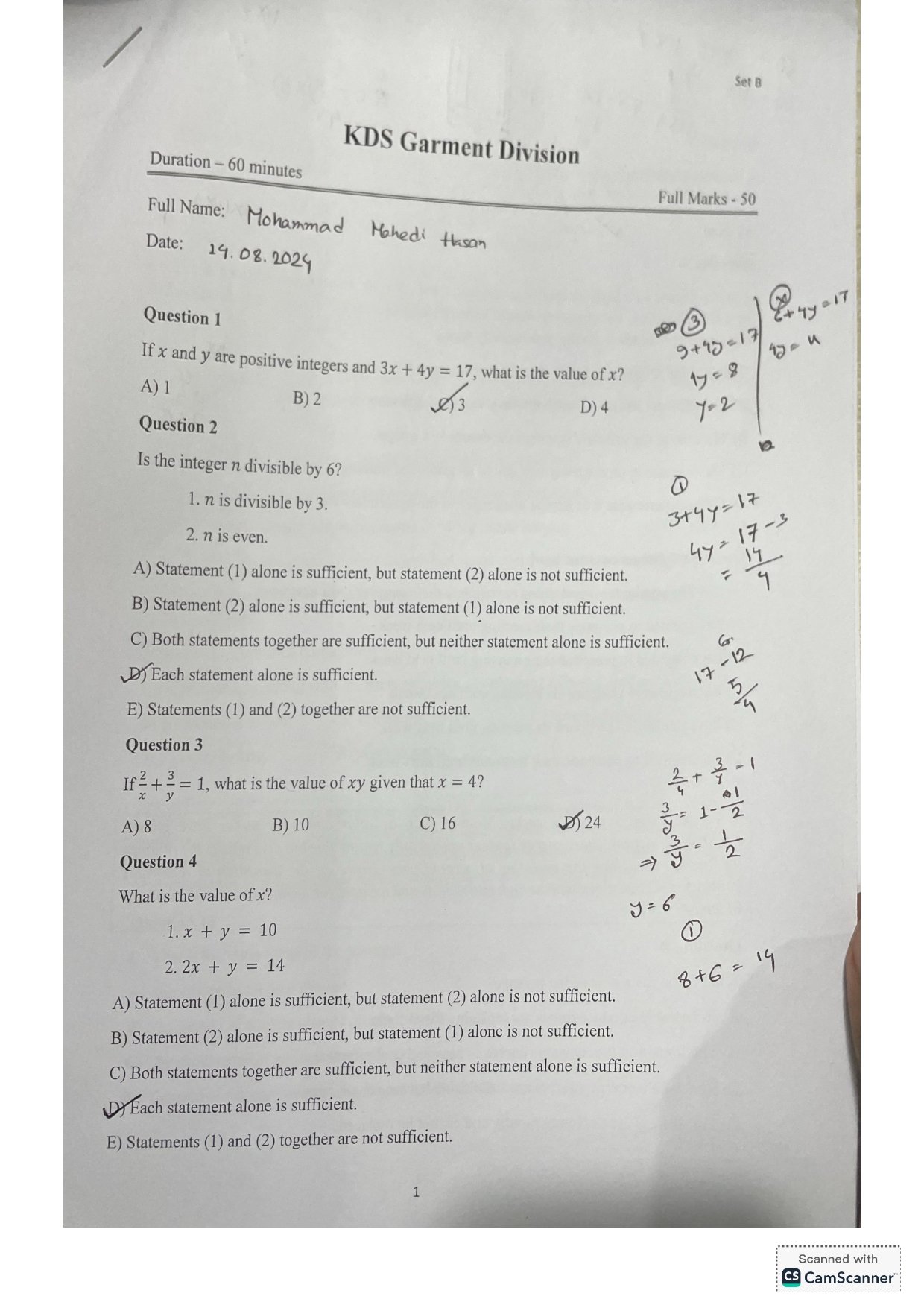
If x and y are positive integers and 3x + 4y = 17, what is the value of x?
Explanation
Substitute each option and check whether y is also a positive integer.
No other positive integer value of x yields a positive integer for y, so x = 3 is the unique answer.
Is the integer n divisible by 6?
1. n is divisible by 3. 2. n is even.
Explanation
Statement 1 alone: n = 3 is divisible by 3 but not by 6. n = 6 is divisible by 3 and by 6. Two different outcomes — not sufficient.
Statement 2 alone: n = 2 is even but not divisible by 6. n = 6 is even and divisible by 6. Not sufficient.
Together: A number divisible by both 3 and 2 must be divisible by 6 (since gcd(2,3) = 1). The two statements together are sufficient.
If 2/x + 3/y = 1, what is the value of xy given that x = 4?
Explanation
2/4 + 3/y = 1
1/2 + 3/y = 1
3/y = 1/2
y = 6
Therefore: xy = 4 × 6 = 24
What is the value of x?
1. x + y = 10 2. 2x + y = 14
Explanation
Statement 1 alone: x + y = 10 has infinite solutions (x=1, y=9; x=2, y=8; …) — not sufficient.
Statement 2 alone: 2x + y = 14 also has infinite solutions — not sufficient.
Together: Subtract equation 1 from equation 2:
x = 4, and therefore y = 6
A unique solution exists only when both statements are used together.
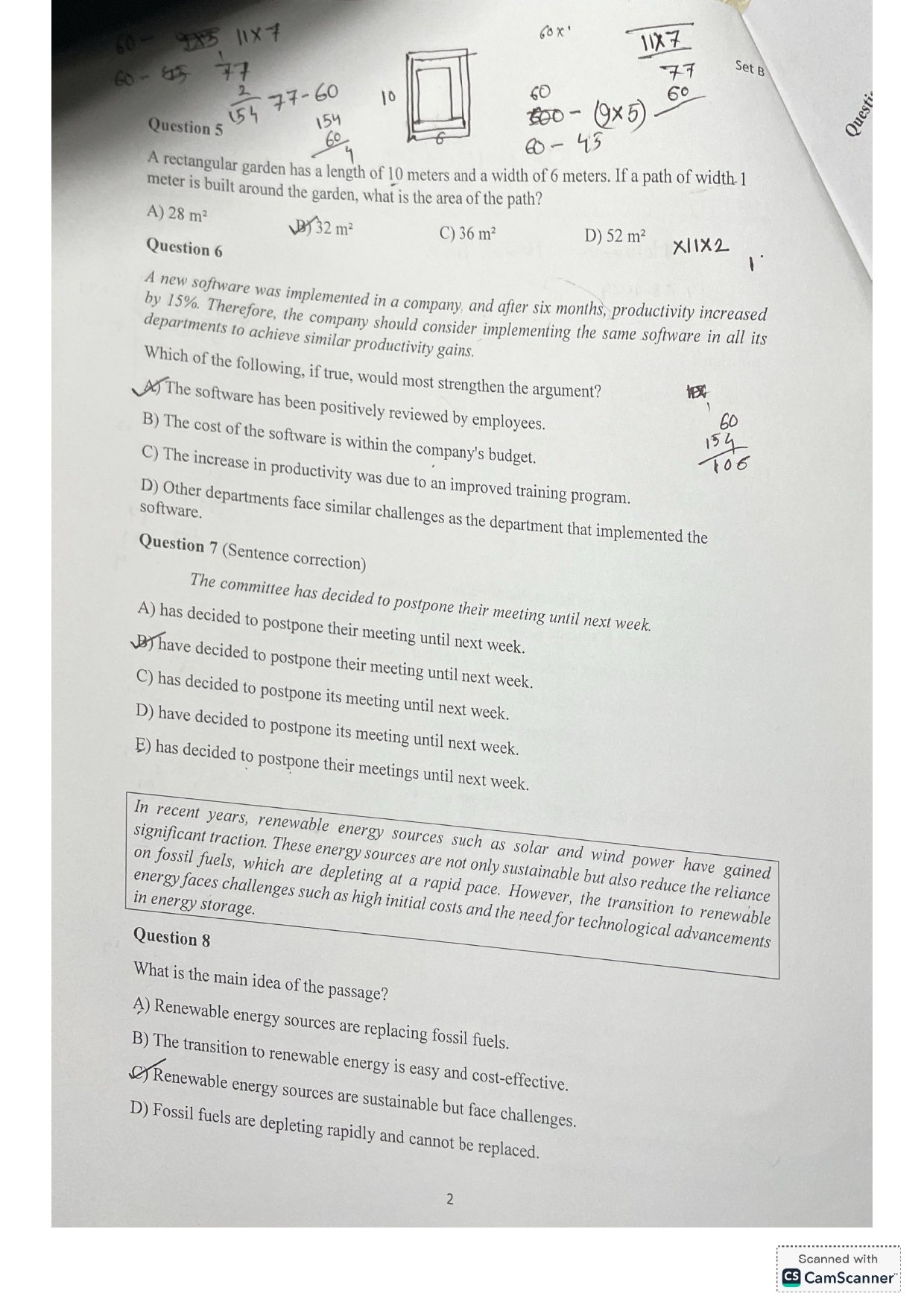
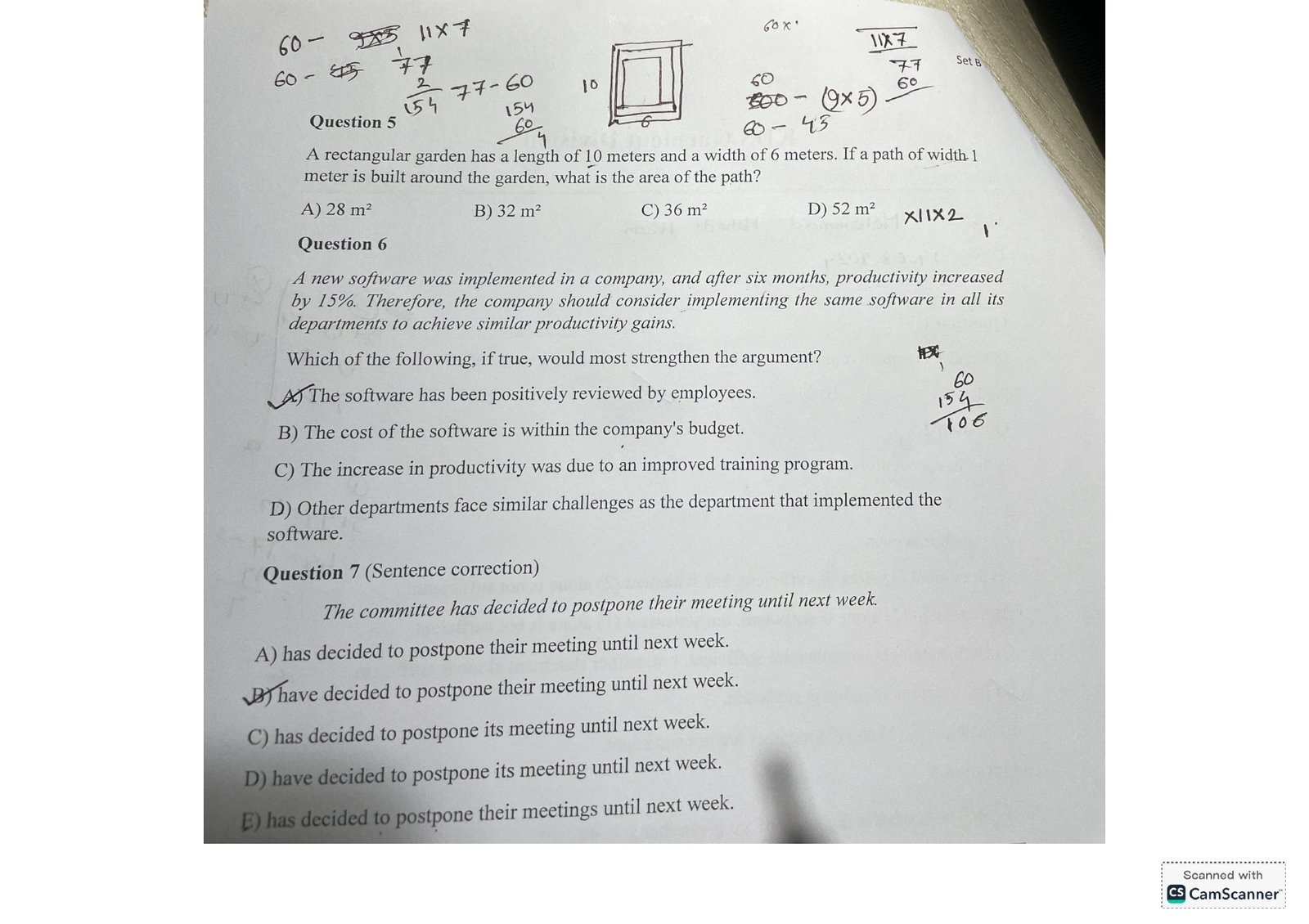
A rectangular garden has a length of 10 meters and a width of 6 meters. If a path of width 1 meter is built around the garden, what is the area of the path?
Explanation
A 1-meter path on all sides adds 1m to each end of both dimensions, so add 2m to each dimension:
Inner garden: 10 × 6 = 60 m²
Path area: 96 − 60 = 36 m²
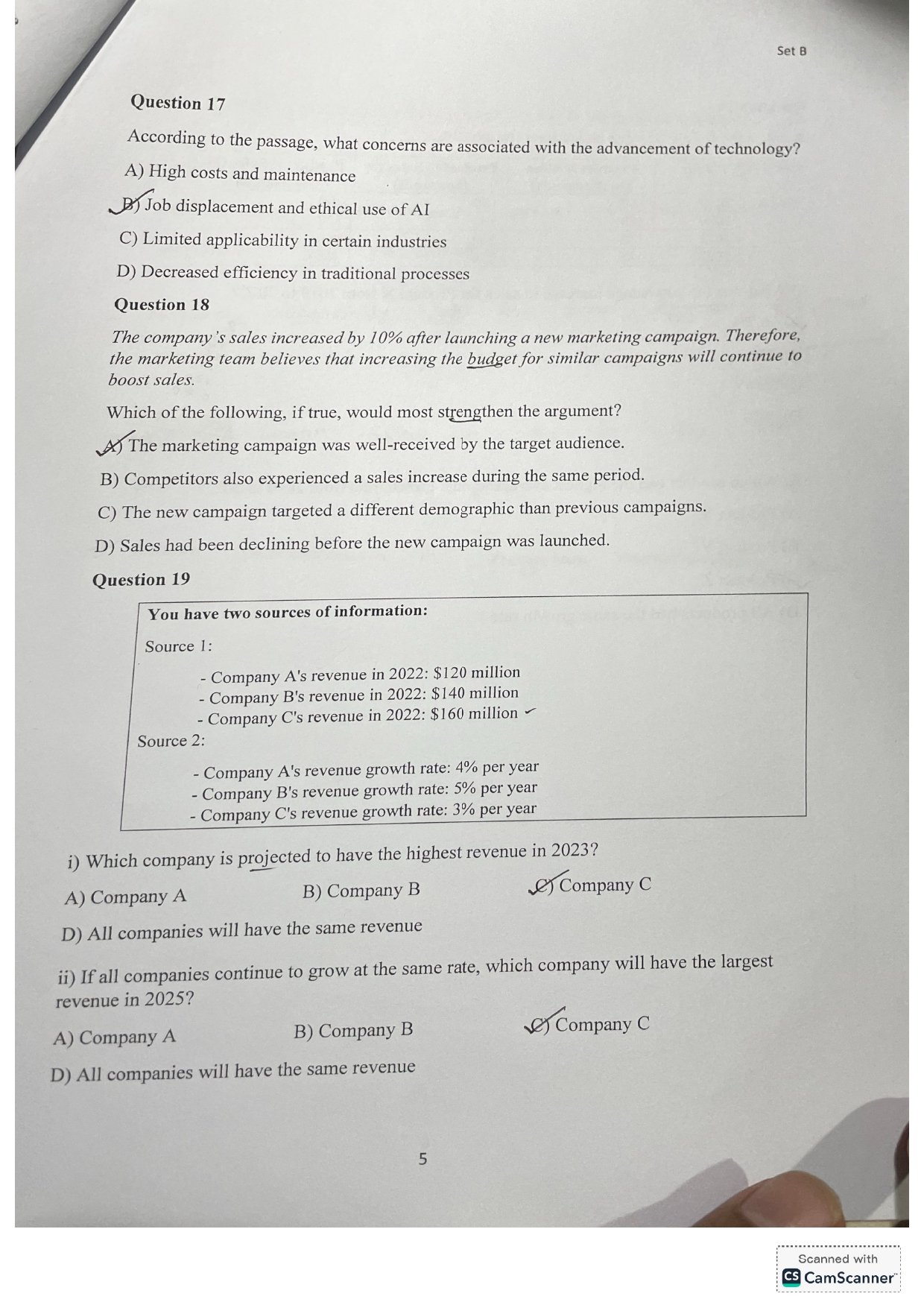
Given the following data, answer both parts.
| Company | Revenue (2022) | Annual Growth Rate |
|---|---|---|
| Company A | $120 million | 4% |
| Company B | $140 million | 5% |
| Company C | $160 million | 3% |
Part i — Which company is projected to have the highest revenue in 2023?
B: 140 × 1.05 = $147.0M
C: 160 × 1.03 = $164.8M ← Highest
Part ii — Which company will have the largest revenue in 2025 (three years of growth from 2022)?
B: 140 × (1.05)³ ≈ $162.1M
C: 160 × (1.03)³ ≈ $174.8M ← Highest
Despite Company C’s lowest growth rate, its substantially higher starting revenue maintains its lead through 2025.
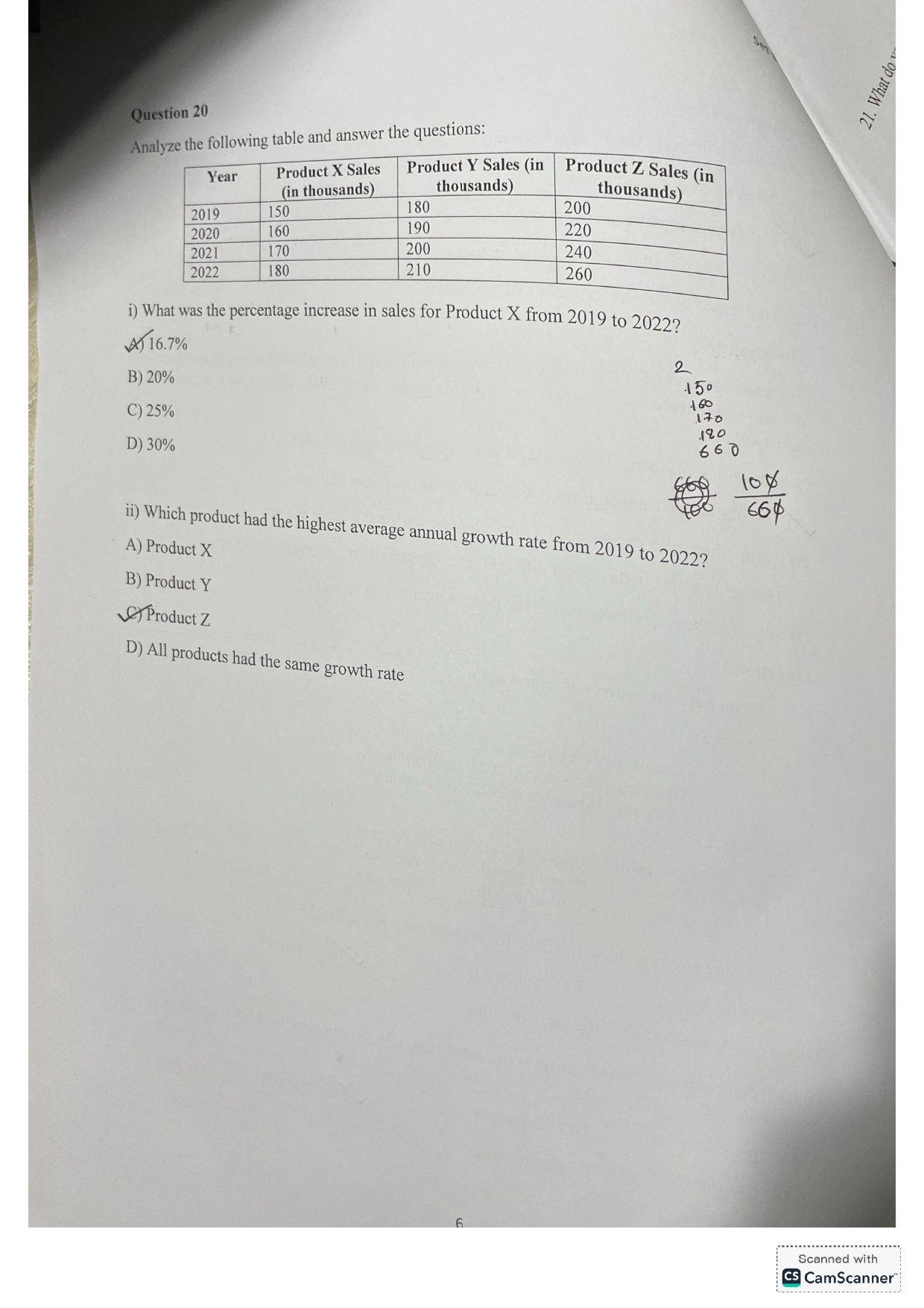
Analyze the following table and answer both questions.
| Year | Product X (thousands) | Product Y (thousands) | Product Z (thousands) |
|---|---|---|---|
| 2019 | 150 | 180 | 200 |
| 2020 | 160 | 190 | 220 |
| 2021 | 170 | 200 | 240 |
| 2022 | 180 | 210 | 260 |
Part i — What was the percentage increase in sales for Product X from 2019 to 2022?
= (180 − 150) / 150 × 100
= 30 / 150 × 100 = 20%
Part ii — Which product had the highest average annual growth rate from 2019 to 2022?
Y: 30 / (180 × 3) = 5.56% per year
Z: 60 / (200 × 3) = 10.0% per year ← Highest
Critical Reasoning — Strengthen & Weaken Arguments
Critical reasoning tests logical thinking — a skill directly relevant to evaluating suppliers, interpreting buyer feedback, and making production decisions in buying and merchandising roles. These question types frequently appear in assistant merchant interview questions and fashion merchandiser interview questions across the industry.
Which of the following, if true, would most strengthen the argument?
Explanation
The argument generalizes from one department’s result to all departments. The logical gap is: will the same software produce the same result elsewhere? Option D closes that gap directly by confirming the conditions are comparable across departments. Option A addresses sentiment, not transferability, so it is a weaker strengthener. Option C actually weakens the argument by suggesting the software was not the real cause.
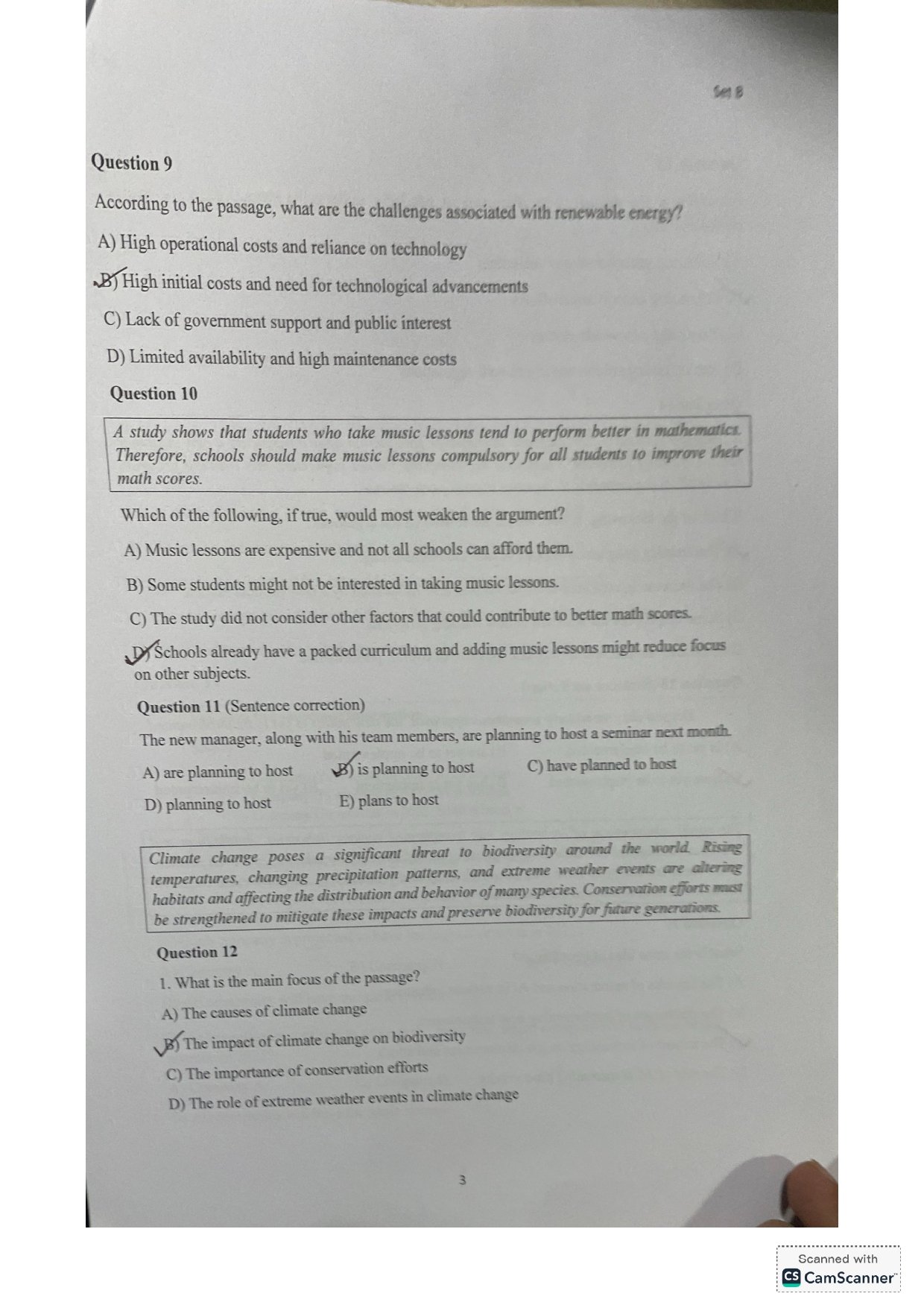
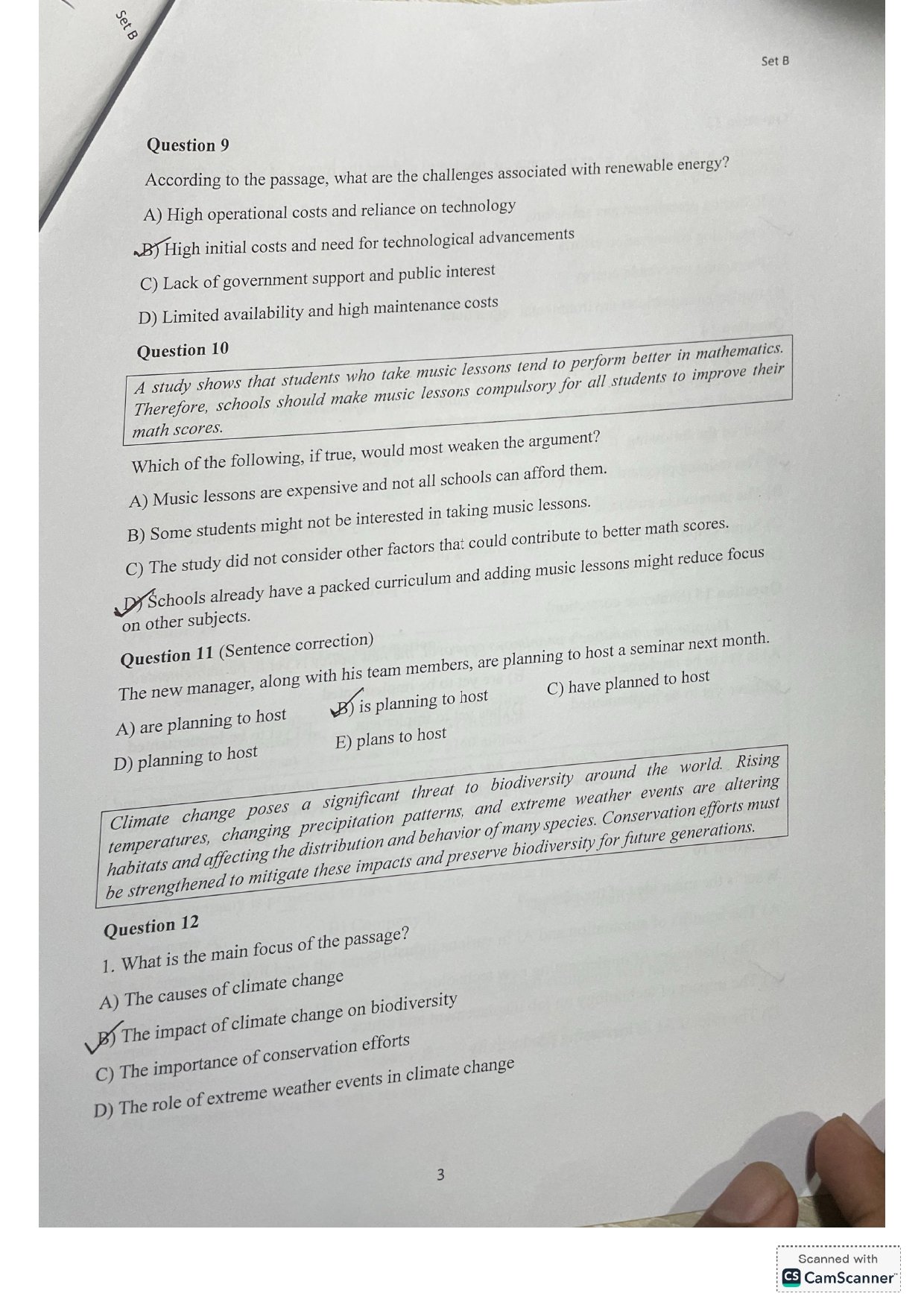
Which of the following, if true, would most weaken the argument?
Explanation
The argument assumes a causal relationship: music lessons cause better math performance. Option C most directly attacks this by pointing to confounding variables — perhaps students who take music lessons also receive private tutoring, or come from households that emphasize academic achievement, making the correlation misleading. Options A and D are practical objections but do not challenge the causal claim itself.
Which of the following, if true, would most weaken the argument?
Explanation
Option B provides an alternative explanation for the satisfaction increase, directly undermining the causal claim that the training program alone drove the result. If the product launch also played a role, expanding the training program may not produce the same outcome. Option A is a cost concern — valid in practice, but it does not challenge the cause-and-effect logic of the argument.
Which of the following, if true, would most strengthen the argument?
Explanation
Option D establishes that sales were already falling before the campaign — meaning the 10% rise cannot be attributed to a natural upward trend. This most powerfully confirms that the campaign caused the increase. Option B actually weakens the argument by suggesting an industry-wide trend was responsible, not the specific campaign.
Reading Comprehension
Reading passages test the ability to extract main ideas and specific details — a skill essential for interpreting buyer briefs, lab dip reports, and approval comments in any merchandising role.
Read the passage above and answer Questions 8 and 9.
What is the main idea of the passage?
Explanation
The passage presents a balanced view: the benefits of renewable energy (sustainable, reduces fossil fuel dependence) alongside its real obstacles (high costs, technology gaps). Option C captures both sides and is the most complete statement of the main idea.
According to the passage, what are the challenges associated with renewable energy?
Explanation
The passage states directly: “the transition to renewable energy faces challenges such as high initial costs and the need for technological advancements in energy storage.” Option B restates this precisely. Note the distinction between operational costs (A) and initial costs (B) — the passage specifies initial.
Read the passage above and answer Questions 12 and 13.
What is the main focus of the passage?
Explanation
The opening sentence establishes the central concern: “Climate change poses a significant threat to biodiversity.” The rest of the passage elaborates on how this threat manifests and what response it requires. Option C is a supporting point, not the main focus.
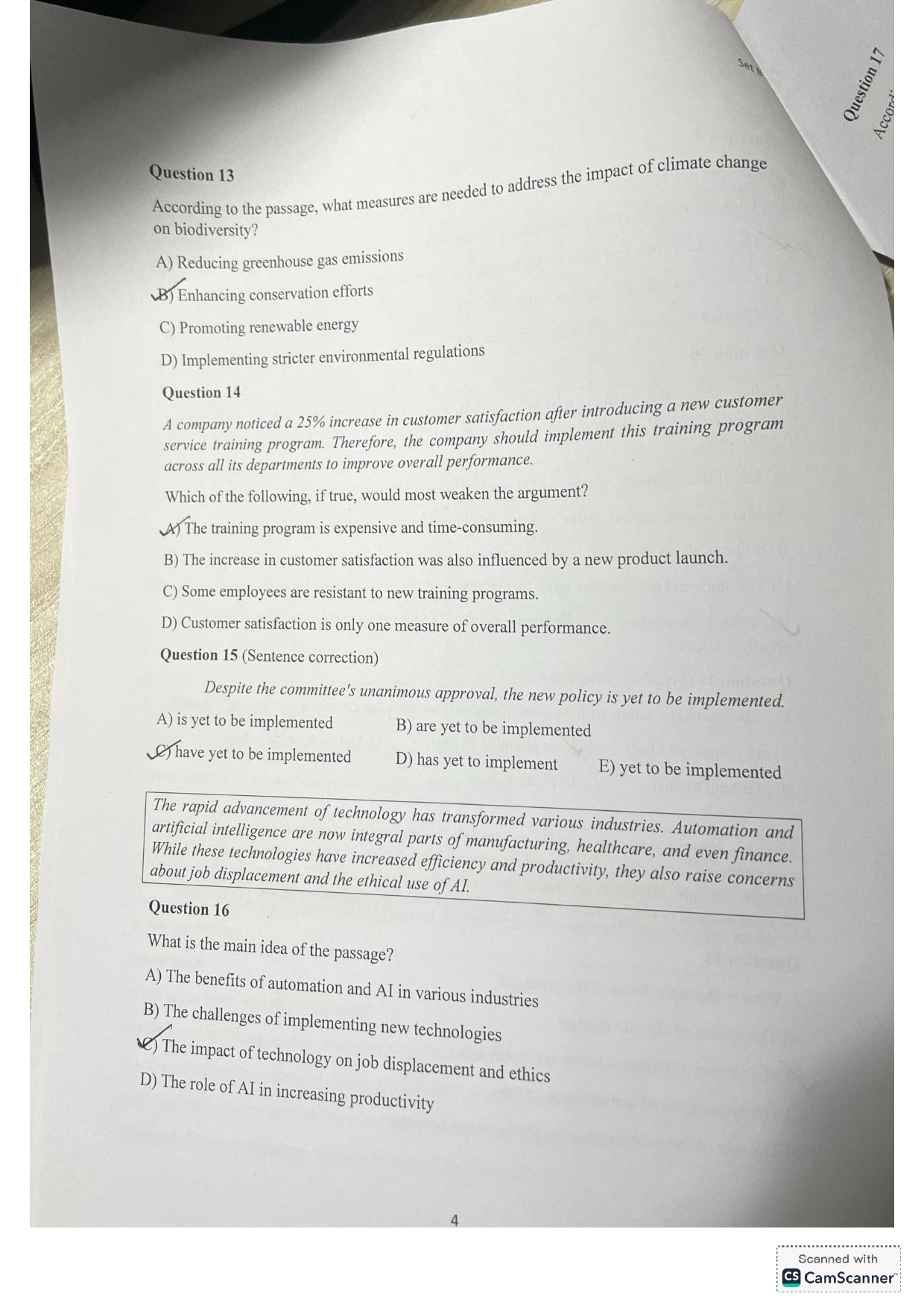
According to the passage, what measures are needed to address the impact of climate change on biodiversity?
Explanation
The passage explicitly states: “Conservation efforts must be strengthened to mitigate these impacts.” Option B directly mirrors this. Options A, C, and D are not mentioned in the passage and should not be inferred.
Read the passage above and answer Questions 16 and 17.
What is the main idea of the passage?
Explanation
While the passage acknowledges the efficiency gains, the final sentence directs attention to the concerns technology raises — job displacement and ethical use of AI. The passage’s overall balance places equal weight on both sides, with the concerns functioning as the lasting takeaway.
According to the passage, what concerns are associated with the advancement of technology?
Explanation
The passage states these concerns directly: “they also raise concerns about job displacement and the ethical use of AI.” Option B is a precise paraphrase of the passage’s own language.
Sentence Correction — English Grammar
Grammar questions appear widely in visual merchandising questions and answers sets and assistant merchant interview questions papers because written communication with international buyers, suppliers, and cross-functional teams is a core job function for any merchandiser.
Original sentence: The committee has decided to postpone their meeting until next week.
Select the correct version of the underlined portion.
Explanation
In standard formal English, collective nouns such as committee, team, management, and board are treated as singular. This requires a singular verb (“has”) and a singular possessive pronoun (“its”). Option C satisfies both requirements.
Option B uses the British English plural convention (“have decided to postpone their”), which is acceptable in some contexts but is marked incorrect in formal aptitude test sentence correction sections where American English rules apply.
Original sentence: The new manager, along with his team members, are planning to host a seminar next month.
Explanation
The phrase “along with his team members” is a parenthetical modifier. It does not change the grammatical subject of the sentence. The true subject is “The new manager” — singular — which requires the singular verb “is planning.” The original sentence’s “are” incorrectly treats the parenthetical as part of a compound subject.
Original sentence: Despite the committee’s unanimous approval, the new policy is yet to be implemented.
Explanation
The subject is “the new policy” — singular. The passive infinitive construction “is yet to be implemented” is grammatically correct and preserves the passive voice appropriate for a policy. Option C, “have yet to be implemented,” uses a plural auxiliary (“have”) that does not agree with the singular subject.
Behavioral & Essay Questions — Model Answers
These open-ended questions (10 marks each) are the most critical section of any assistant merchandiser interview questions and answers guide. Whether you are preparing for visual merchandiser job interview questions or trainee merchandiser interview questions at a garment factory, interviewers award marks for structure, specificity, industry relevance, and clarity of communication.
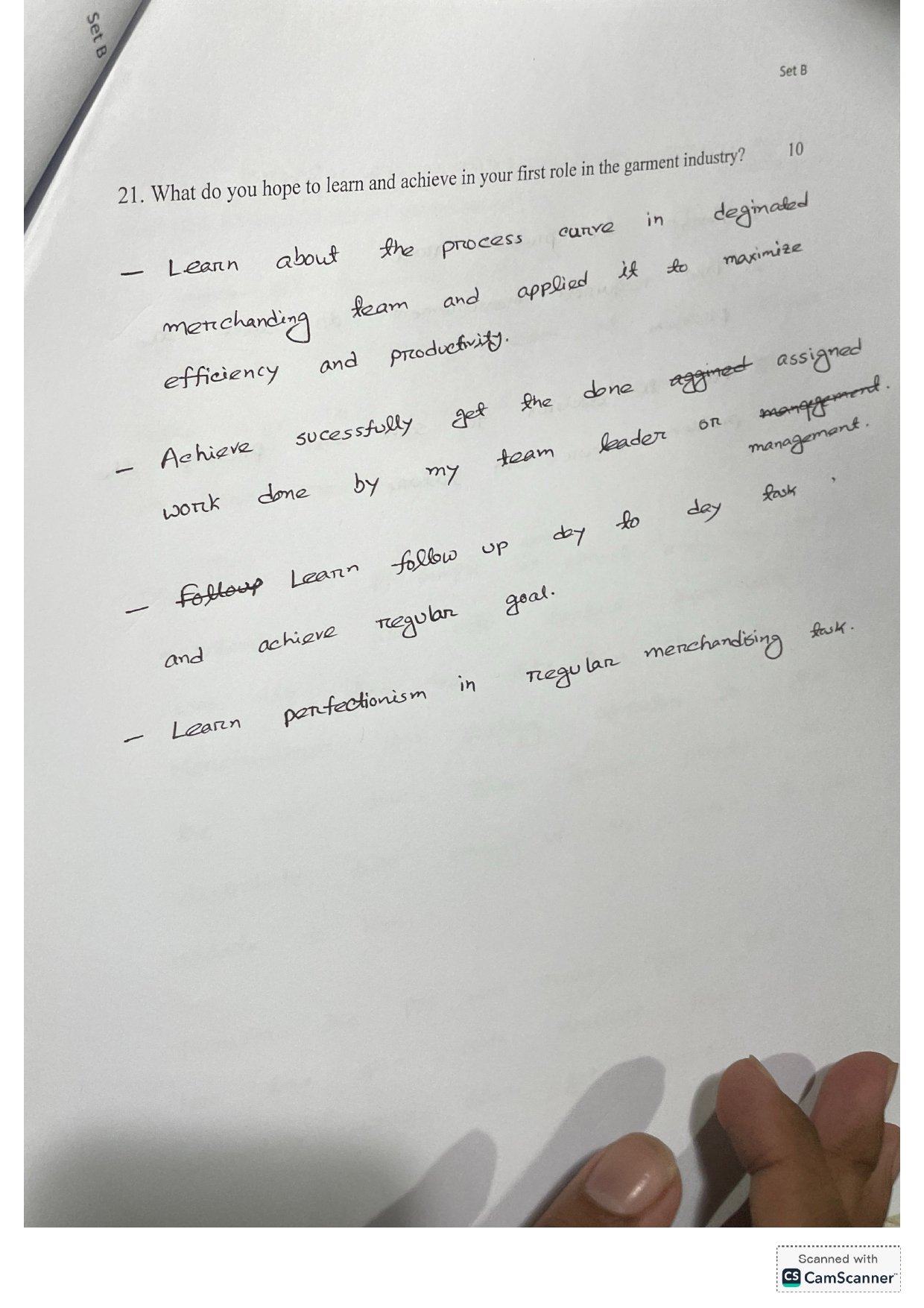
What do you hope to learn and achieve in your first role in the garment industry?
In my first role as an assistant merchandiser in the garment industry, I aim to build a strong and balanced foundation — combining technical product knowledge with professional communication and execution discipline.
Learning Goals
- Master the end-to-end merchandising process. I want to develop a thorough understanding of every stage of the order lifecycle — from buyer inquiry and order confirmation, through fabric and trim procurement, PP sample approval, production follow-up, inspection, and final shipment. This is especially important in woven merchandising, where product complexity and timeline pressure are both high.
- Develop critical path discipline. I aim to learn how to read and actively manage a Time and Action (TNA) calendar — identifying delays early, escalating when necessary, and communicating proactively with all stakeholders rather than waiting for problems to surface.
- Build technical product knowledge. Understanding fabric compositions, construction methods, buyer quality standards, and trim specifications will allow me to contribute meaningfully to both internal production coordination and external buyer communications.
Achievement Goals
- Deliver all assigned tasks accurately and on schedule, establishing a reputation for reliability from the first week.
- Contribute to at least one successful on-time shipment within my first 90 days in the role.
- Build collaborative working relationships with cross-functional teams — production, QC, sourcing, and logistics — so that coordination becomes natural rather than reactive.
- Grow into a fully independent merchandiser, capable of managing my own buyer accounts, within 2 to 3 years.
I believe the garment industry rewards people who combine attention to detail with a sense of urgency. That is the professional standard I intend to hold myself to from the first day.
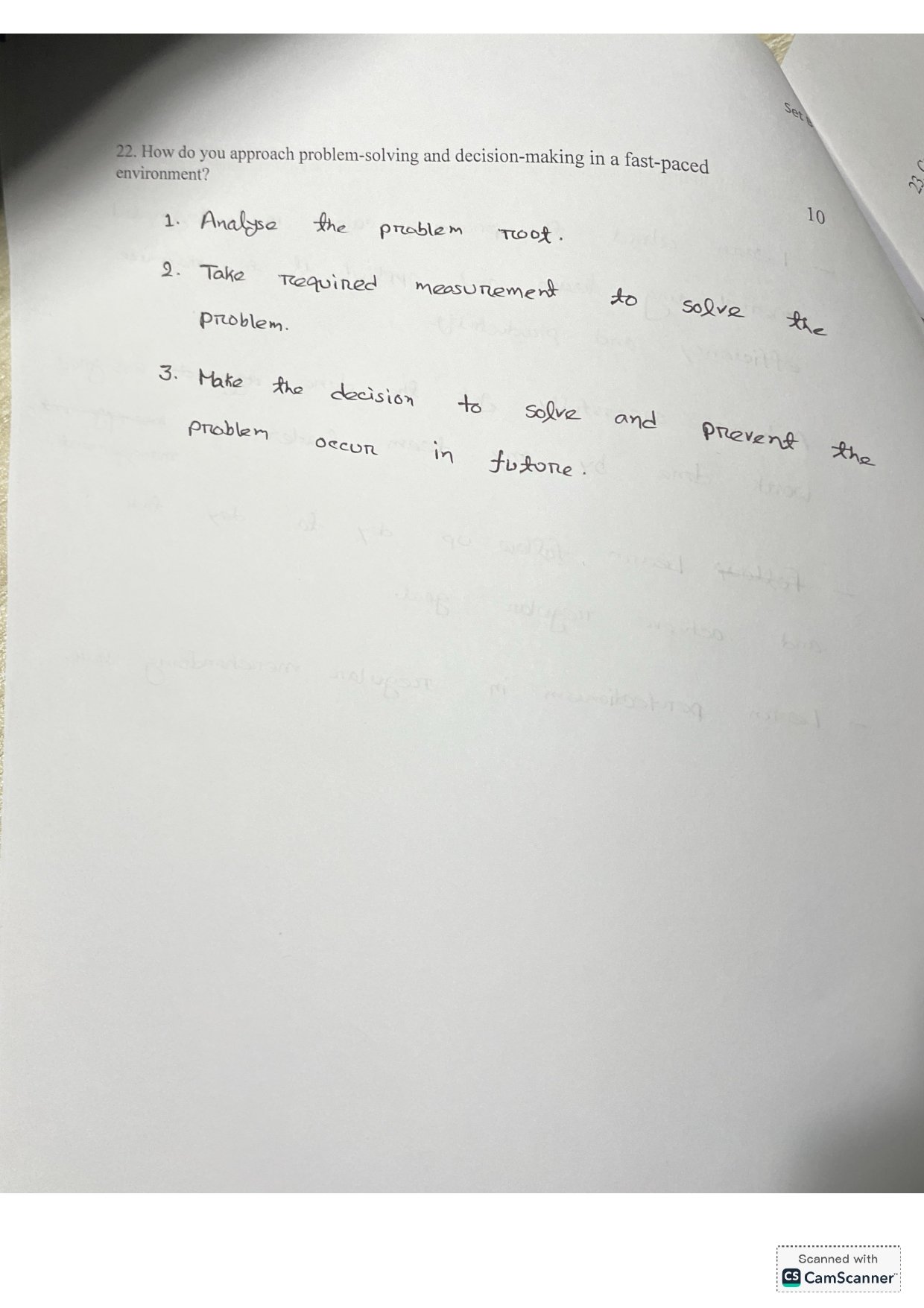
How do you approach problem-solving and decision-making in a fast-paced environment?
The garment industry operates on timelines where a single unresolved problem can cascade into a shipment delay. My approach to problem-solving in this environment follows three structured steps.
Step 1 — Identify the Root Cause, Not Just the Symptom
Before taking any action, I analyze the problem at its source. For example, if a buyer raises a measurement concern on a PP sample, I do not simply re-sew the garment. I first determine whether the issue originates from the pattern, fabric shrinkage, cutting tolerance, or a misread specification in the tech pack. Addressing the symptom without finding the root cause wastes time and guarantees recurrence.
Step 2 — Assess Resources and Act in Parallel
Once the root cause is clear, I identify the people, materials, and decisions required and initiate multiple actions simultaneously rather than sequentially. In critical path situations, I contact the production floor, QC team, and sourcing department at the same time. Waiting for one department to respond before approaching the next is a luxury that fast-moving orders do not allow.
Step 3 — Decide, Execute, and Prevent Recurrence
After the immediate issue is resolved, I document what happened, why it happened, and the corrective action taken. I share this with the relevant team members and update any applicable checklist or standard operating procedure so the same error does not affect a future order. This follow-through discipline is what separates short-term firefighting from long-term process improvement.
This approach — structured diagnosis, parallel execution, and disciplined follow-up — is what I believe makes effective decision-making possible even under significant time pressure.
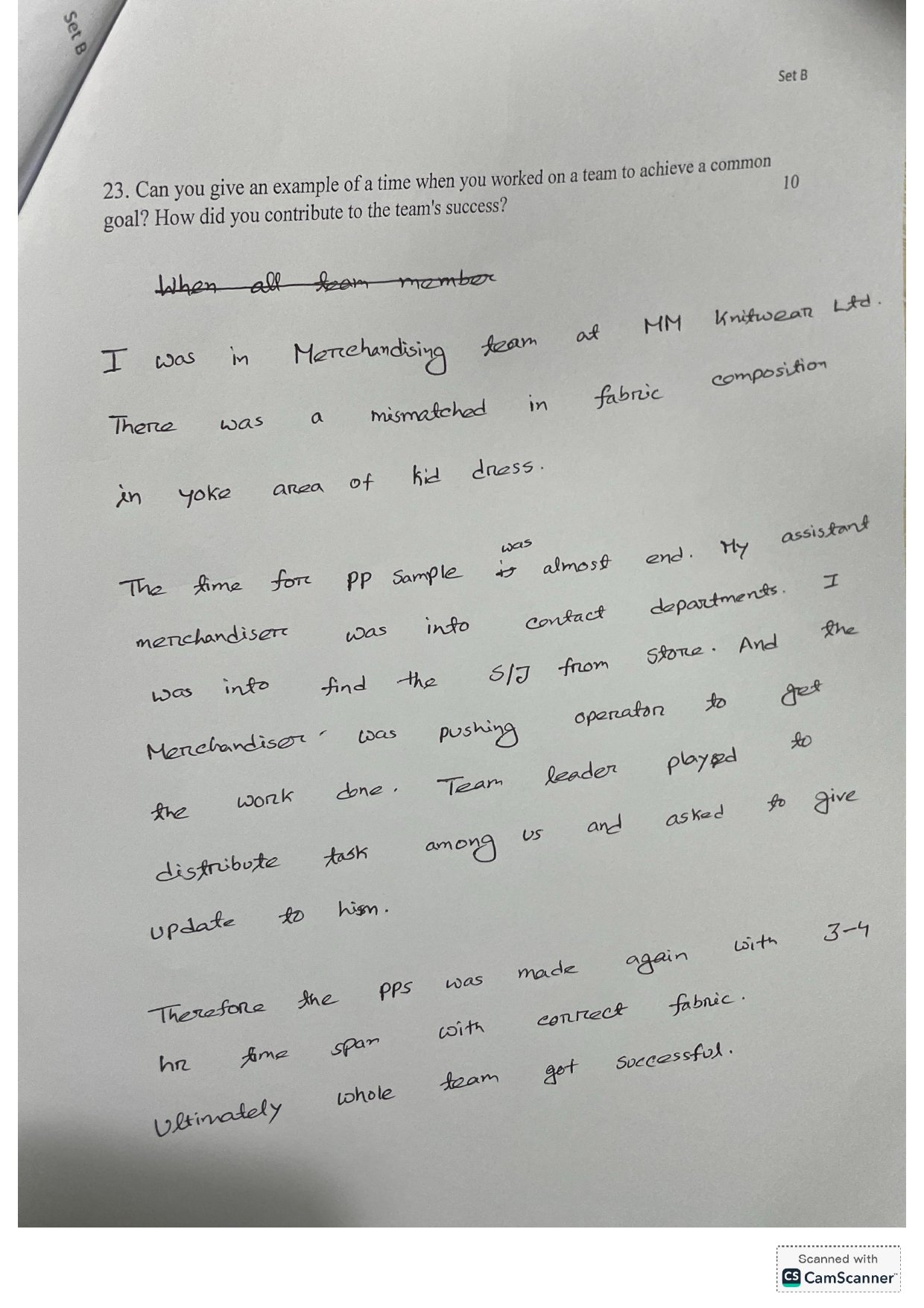
Can you give an example of a time when you worked on a team to achieve a common goal? How did you contribute to the team’s success?
Situation
While working as a member of the Merchandising Department at MM Knitwear Ltd., our team encountered a critical quality issue at the Pre-Production (PP) sample stage for a children’s dress order. We discovered a fabric composition mismatch in the yoke area — the yoke fabric differed in fiber content from the body fabric — which was a clear non-compliance with the buyer’s specification. The PP sample submission deadline was approaching rapidly, and there was no time to place a new fabric order.
Task
As a team member, my responsibility was to coordinate with the store and production departments to locate the correct fabric from existing inventory and ensure the revised sample could be completed within the remaining time window.
Action
Our team leader immediately assessed the situation and divided responsibilities among the team. I was assigned to contact the store department, confirm whether the correct single jersey (S/J) fabric was available in the required specification, and arrange its release to the cutting floor without delay. Simultaneously:
- The team leader coordinated with the production supervisor to prioritize the revised cutting and sewing immediately after fabric release.
- The senior merchandiser maintained direct communication with the buyer’s representative to manage expectations without alarming them unnecessarily.
- Each team member gave real-time updates to the team leader so that decisions could be escalated or made instantly without waiting for scheduled meetings.
Result
Within 3 to 4 hours, the revised PP sample was produced with the correct fabric composition, passed internal QC review, and was submitted to the buyer on schedule. The buyer approved the sample without raising any concerns about the yoke composition, and the order proceeded on time.
The experience reinforced my conviction that in the garment industry, clear role division, fast communication, and genuine trust among team members are as important as any individual technical skill. These are qualities I bring to every collaborative task.
Complete Answer Key
| Question | Correct Answer | Topic |
|---|---|---|
| 1 | C (x = 3) | Algebra — positive integer substitution |
| 2 | C | Data sufficiency — divisibility by 6 |
| 3 | D (xy = 24) | Algebra — algebraic substitution |
| 4 | C | Data sufficiency — linear system |
| 5 | C (36 m²) | Geometry — area of border path |
| 6 | D | Critical reasoning — strengthen (similar conditions) |
| 7 | C | Grammar — collective noun + singular pronoun |
| 8 | C | Comprehension — main idea (balanced view) |
| 9 | B | Comprehension — high initial costs and technology |
| 10 | C | Critical reasoning — weaken (confounding variables) |
| 11 | B | Grammar — singular subject, intervening phrase |
| 12 | B | Comprehension — climate change impacts biodiversity |
| 13 | B | Comprehension — enhance conservation efforts |
| 14 | B | Critical reasoning — weaken (alternative explanation) |
| 15 | A | Grammar — singular subject agreement |
| 16 | C | Comprehension — technology and job displacement |
| 17 | B | Comprehension — job displacement and ethical AI |
| 18 | D | Critical reasoning — strengthen (declining baseline) |
| 19 (i) | C (Company C) | Revenue projection — 2023 |
| 19 (ii) | C (Company C) | Revenue projection — 2025 |
| 20 (i) | B (20%) | Percentage increase — Product X |
| 20 (ii) | C (Product Z) | Highest average annual growth rate |
| 21 | Model answer above | Essay — career goals in garment industry |
| 22 | Model answer above | Essay — problem-solving in fast-paced environment |
| 23 | Model answer above | Essay — teamwork example (STAR format) |
Preparation Tips for Aspiring Merchandisers
These tips apply to anyone facing assistant merchandiser interview questions, woven merchandising interview questions, visual merchandiser job interview questions, or any buying and merchandising interview questions in the Bangladesh garment sector.
Data Sufficiency Strategy
Always test a statement with at least two different values before deciding it is sufficient. A single value that works does not prove the statement is always sufficient.
Percentage Change Formula
Divide by the original (base) value — never the final value. Percentage change = (New minus Original) divided by Original, multiplied by 100.
Critical Reasoning Rule
Identify the conclusion and the gap between evidence and conclusion. The strongest strengthener closes that gap; the strongest weakener widens it or introduces an alternative explanation.
Grammar: Intervening Phrases
Phrases beginning with “along with,” “as well as,” or “in addition to” are parenthetical. They do not change the grammatical number of the subject.
Use the STAR Format
Structure every behavioral answer as Situation, Task, Action, Result. Be specific about what you personally did and what the measurable outcome was.
Know Your Industry Vocabulary
Terms like PP sample, TNA calendar, critical path, tech pack, single jersey, and fabric composition signal industry readiness to any interviewer conducting trainee merchandiser interview questions.
Frequently Asked Questions
Answers to common questions about assistant merchandiser interview questions and answers, garment company aptitude tests, and career preparation for the RMG sector.
What topics are covered in an assistant merchandiser written test?
What is a data sufficiency question and how should I approach it?
How do I calculate the area of a path built around a rectangle?
What is the STAR format and why is it important for behavioral interview questions?
What is the difference between strengthening and weakening an argument in critical reasoning?
How should collective nouns be treated in English grammar for sentence correction?
How do I correctly calculate percentage increase for aptitude tests?
What subjects should I study for woven merchandising interview questions?
What is an MTO question in garment company exams?
How do visual merchandiser interview questions differ from assistant merchandiser interview questions?
From global fashion brands that administer visual merchandiser interview questions H&M-style assessments to RMG factories in Bangladesh, written tests cover quantitative reasoning, data sufficiency, critical thinking, English grammar, reading comprehension, and behavioral competency. Whether you are a fresh graduate exploring trainee merchandiser interview questions or an experienced professional reviewing buying and merchandising interview questions, this guide addresses every topic tested.

Mahedi Hasan working as an Executive (Fabric Marketing) at Pengnuo Group. Graduated with B.Sc. in Textile Engineering. Before was a Top Rated content writer at Upwork, and Level 02 Seller at Fiverr, Level 02 Publisher at Ezoic. Very passionate about content writing, SEO practice, and fashion website designing. Highly Experienced fashion writer for the last 4+ years. Have extensive 7 years of experience in the wholesale clothing business.